
Facing fragmented delivery cycles following a rapid product expansion, the engineering and product leads needed a unified operating rhythm.
SKILL-BASED LEADERSHIP AND CAPABILITY DEVELOPMENT
Leadership programmes feel inspiring. So why do results keep falling short?

You are accountable for what your people deliver. You also want them to grow while they do it, and to still be here in two years. Nobody has ever told you those are the same problem.
So you have done the sensible things. The programme, the offsite, the framework someone swore by. Skilled facilitators, strong content, excellent feedback. And six months later the same people are handling the same situations the same way.
That is not your fault. The problem is not intention.
The problem is method.
Skill is the atomic unit of capability. Almost nothing in this industry ever gets to it.
Benny Ausmus. Author of Leading with Skill. Twenty years of this work.
Micro Skill, OHIO - 20 July 26
THE DIAGNOSIS
The four patterns most development falls into.
PATTERN ONE
The Satisfaction Trap
High satisfaction, no skill development. Possibly inversely related.
4.7 out of 5, and nothing changed.
PATTERN TWO
The Content Treadmill
A new framework every year. Same result, rising spend.
Better vocabulary, same behaviour.
PATTERN THREE
The Manager Gap
Development happens in a bubble. Managers are not involved.
It stays with the facilitator and leaves with them.
PATTERN FOUR
The Measurement Void
No way to connect the investment to an outcome.
You have receipts. You do not have a statement.
THE BOOK
Leading With Skill
Make the shift from passive content to active capability.
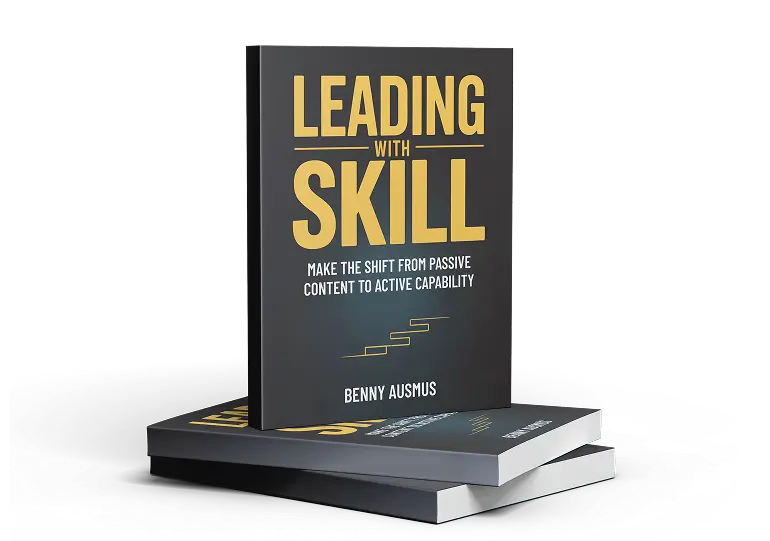
It is not for sale. It is given to people who are working on this problem seriously.
If the four patterns above described your organisation, ask me for a copy and I will post one to you.
THE DISTINCTION
Information isn't capability
Knowing about emotional intelligence is not the same as being emotionally intelligent. Understanding feedback principles is not the same as delivering feedback under pressure. Learning about strategic thinking is not the same as thinking strategically when the stakes are high.
Most programmes teach leaders about leadership, measure whether they learned the content, and celebrate when they can recite the frameworks.
Then we wonder why nothing changes.
Capability is made of skills.
Skills break down into smaller skills, and they keep breaking down until you reach something small enough to actually practise.
That is where development becomes possible. Get to the level where practice is possible, build the skill in real work conditions, and measure whether it moved.
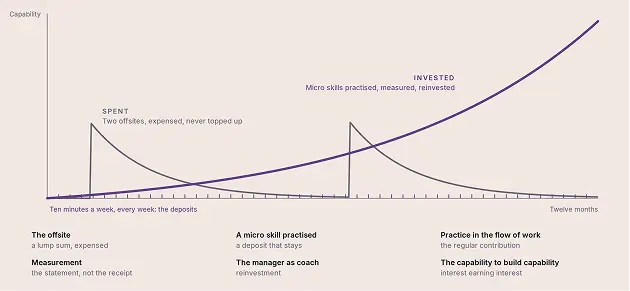
Most development is spent. A lump sum on an offsite, gone by the end of the quarter. Skill is invested. Every practised skill is a deposit that stays.
Where the work sits
Strategy says what to achieve. Nobody says what people must become able to do.
Strategy
says what the organisation must achieve.
Skill
says what its people must become able to do.
Practice
is how they become able to do it.
Measurement
is how everyone knows it happened.
Theirs
The Work. Strategy firms are a channel, not a competitor.
THE LADDER UNDER EVERYTHING
Most programmes stop at the first word.
Information
Models, frameworks, content. Necessary. Not capability.
WHERE MOST PROGRAMMES STOP
Skill
Specific enough to name, small enough to practise, real enough to measure.
Wisdom
Knowing which skill, when. Grows from the reps.
Results
What the CFO can see.
THE ARCHITECTURE OF SKILL
Only at the smallest level does practice become possible.
MEGA
Commercial acumen and financial fluency
The capability the strategy needs
MACRO
Translating numbers into stakeholder language
A skill a role must hold
MINI
Reading a P&L at first sight
Named, observable, coachable
MICRO
State the metric in the language of the person in front of you, in your next fifteen meetings
Practisable by Friday. Measurable by the quarter.
DECOMPOSE UNTIL IT IS SMALL ENOUGH TO DO
THE SKILL HIERARCHY
One capability, four levels, and the four skills that build them all.
1
The capability the strategy needs
6
The skills a role must hold
24
Named, observable, coachable
72
Practisable in
tomorrow's meeting
MEGA
MACRO
MINI
MICRO
THE META SKILLS
Skills for building skills, at every level
Skill Setting
Choose and decompose the skill
Truth Seeking
Find out where you actually are
Active Practice
Reps in real work conditions
Reflexivity
Notice, adjust, feed forward
THE PRACTISABLE LAYER. EVERYTHING ABOVE IT IS A DESCRIPTION OF THE DESTINATION.
RUNS THROUGH
EVERY LEVEL
Counts from a financial adviser skills framework built in 2026. The shape is constant; the numbers change by capability.
Numbers
A Very Expensive Habbit
$366B
Spent globally each year on leadership development.
Only 40%
Of leaders say their organisation has high-quality leaders. The steepest decline in a decade.
335
Studies showing leadership development works when it is designed to work. Practice-based methods, spaced sessions, real needs analysis, follow-up. Most programmes ignore all four.
Hope is not a development methodology.
That third number is the important one. This is not an argument that development is hopeless. It is an argument that most of it is badly designed.
THE METAPHOR
Most development is spent. Skill is invested.
The offsite is a lump sum, expensed, never topped up. A micro skill practised on purpose is a deposit that stays. Practice in the flow of work is the regular contribution. Measurement is the statement, not the receipt. The manager as coach is reinvestment. And the capability to build capability is where the interest earns interest.
THE MOST EXPENSIVE YEAR IS THE ONE YOU WAIT.
WHY ORGANISATIONS DO THIS
The workshop is not the development. It is the setup for it.
Time
You will spend some days in a room. That is where the skill gets named, scoped and cut down to something practicable. Everything after that runs inside work your people are already doing, which is why a half day becomes months of development rather than a day of content.
Money
The skills are mapped to your strategy, so developing them is how the strategy gets delivered. The same hours build capability and hit the numbers
Standing
When you can show what changed, the function stops being a cost centre. Development becomes the reason the strategy landed, and you are the person who brought it in.
People
People return to the way they learned everything they are good at: by doing it, with someone watching who can see it. They get more curious, more willing to be bad at things in front of others, and harder to intimidate.
ANYWHERE
Four things that do not exist together anywhere else
ONE
Validated developmental measurement
Validated developmental measurement. I am a Certified Master Lectical Coach and a Certified Professional Lectical Consultant. Very few people hold this. It means I can measure the structure of how a person actually thinks, against fifty years of research, rather than asking them what they prefer.
TWO
An architecture that runs all the way down
An architecture that runs all the way down. From the capability an organisation needs, to the capability a person owns, to something small enough to practise in your next conversation. Most models stop several levels above the point where practice becomes possible.
THREE
A system that produces observable change on purpose
A system that produces observable change on purpose. Prime, Plan, Practice, Progress. It runs in real work conditions rather than in a room, which is why the change survives contact with the job.
FOUR
A Second Business at the selection end
A second business at the selection end. I also run a developmental assessment and recruitment practice. The same unit of measurement runs through both, which means I speak to the hiring end of the chain from practice rather than theory.
A large consultancy has none of the four, and cannot acquire the first.
How the work runs
A way of working, not a programme
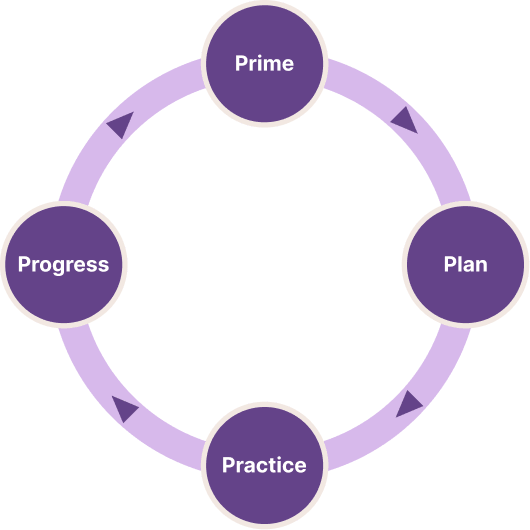
Prime
Why this skill, for this work. Readiness, manager
involvement, the environment.
Plan
One card. One rep. One week. The micro skills, the practice
opportunities, the measures.
Practice
In the meeting, on the call, in the project. Repetition,
capture, feedback.
Progress
Reflect, log, re-measure. Visible improvement fed into the
next cycle.
Ten minutes a week. One hour a fortnight. One day a quarter.
The process is the practice. The method teaches the method.
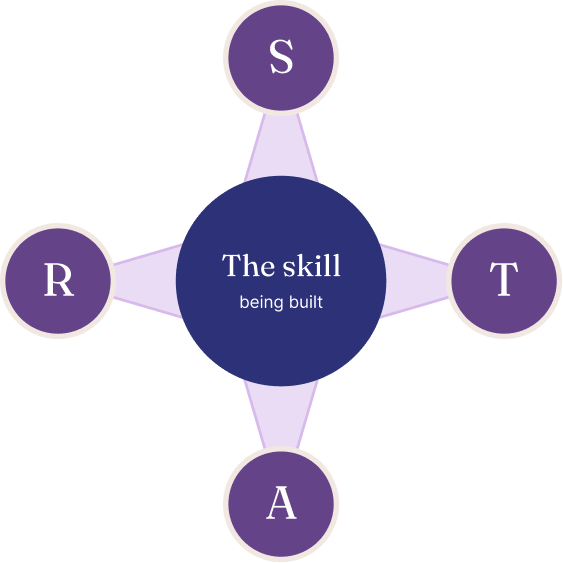
Skill Setting
Break the capability down until you reach something
practisable, and choose the right thing to work on.
Truth Seeking
Find out where you actually are. The minimum you need to
know to practise well, from feedback, evidence and
exemplars.
Active Practice
Practise with intention in real work conditions. Set up
the attempt, notice what happened, adjust.
Reflexivity
Capture what you observed, review it on a rhythm, and feed
it back into the next attempt.
Skills for building skills. The method teaches the method.
One meta skill per chapter of Leading with Skill. Runs inside
every beat of 4P.
Skill Cards
Built by the leader through their own Truth Seeking, not handed to them. One card, one rep, one week. Micro skills are observable by design, so a manager can watch for them, name them and give feedback without being trained as a coach.
WHERE DOES YOUR FUNCTION SIT?
Five stages. Most organisations sit at two.
The currency is what you can truthfully say in the budget meeting. The line between two and three is the moment a skill gets named. Below it nothing can be practised or measured. Above it, everything can.
TAKE THE DIAGNOSTIC AND FIND YOUR STAGE
Compounding
Managers coach with the method. Skill is one currency.
“We build capability faster than the environment changes.”
Evidencing
Baseline, re-measured, behaviour change recorded.
“We can show what changed.”
Practising
Strategy decomposed to micro skills. Managers involved.
“They are practising named skills in real work.”
TIPPING POINT: A SKILL GETS NAMED
Informing
Frameworks, offsites, a new model every couple of years.
“They attended.”
Hoping
Feel-good programmes judged on enjoyment.
“They loved it.”
TWENTY YEARS OF THIS WORK
The measurement is real
Most assessment tells you what someone prefers. Personality profiles, styles, strengths inventories. Useful for a conversation, useless for measuring growth, because preferences do not develop.
Lectical assessment measures something else. The structure of a person’s thinking. How many things they can hold at once, how they reconcile competing demands, how they reason when the situation is genuinely hard. It is built on fifty years of developmental research, from Piaget through Kurt Fischer’s dynamic skill theory to Theo Dawson’s work on measurement.
It is scored against a validated scale, which means growth becomes a number that means something.
That is the difference between believing someone has grown and being able to show it.
Currently supporting capability development across more than 1,300 advisers in a privately held financial advice group.
Accredited by


Work has included







CASE STUDIES
CASE STUDy
Cross-Functional Alignment
Baseline:
42% on-time delivery
The Change:
86% on-time delivery
Time:
6 months
CASE STUDy
Cross-Functional Alignment
Facing fragmented delivery cycles following a rapid product expansion, the engineering and product leads needed a unified operating rhythm.
Baseline:
42% on-time delivery
The Change:
86% on-time delivery
Time:
6 months
CASE STUDy
Cross-Functional Alignment
Facing fragmented delivery cycles following a rapid product expansion, the engineering and product leads needed a unified operating rhythm.
Baseline:
42% on-time delivery
The Change:
86% on-time delivery
Time:
6 months
WHAT CHANGED
Not what they thought of the programme. What they do differently.
Every quote here names a specific behaviour. That is deliberate. If someone can only tell you they enjoyed it, nothing happened.
These aren't just career skills. They're a system for developing life skills.
Aaron Zol
Head of Business and Insurance Advice Growth
It's refreshing to have leadership training with tangible, clear guidance and next steps.
Tanja Zurak
National Manager Business Development
A practical way to embed learning and new skills daily, in an achievable way.
Bec Dale
Head of Platform Operations
I really spent some time thinking deeper than usual about why I do certain things.
Michael Doce
Commercial Reporting and Insights Manager
Interesting, engaging, and it set a great vibe in the room.
Grace Oldaker
Team Manager Advice Operations
Very interactive, where people share their insights and views in a psychologically safe way.
Participant
Leading with Skill, Intensive One
Breadth without dilution
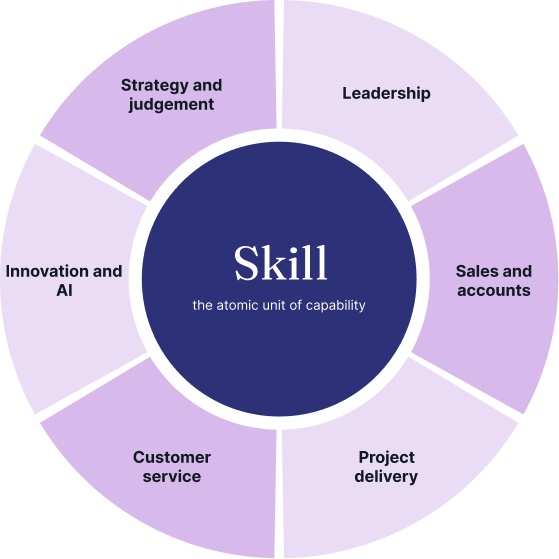
One Claim. Many Applications.
execution,
prioritisation
resolution, complaints,
churn
engagement, bench
strength, change
adoption
on time, on scope, less
rework
pipeline, conversion,
share of wallet
adoption, experiments,
time to value
- Execution, Prioritisation
- Engagement, Bench Strength, Change Adoption
- Adoption, Experiments, Time To Value
- Pipeline, Conversion, Share Of Wallet
- Resolution, Complaints, Churn
- On Time, On Scope, Less Rework
Same architecture of skill. Same 4P cycle. Same measurement.
THE DOMAIN IS THE VARIABLE. THE METHOD IS THE CONSTANT.
TWO SITUATIONS
The same method. Two very different problems.
You run a function or a business unit
You have a strategy you are accountable for and a group of people who are not yet able to deliver it. It might be a sales number, a delivery problem, a service score or a plan nobody can execute. Development happens, at some expense, and you cannot point to what it changed. The work here maps your strategy down to the skills your people must actually acquire, measures where they currently are, builds those skills inside the work, and gives you evidence at the end that an executive will accept.
You own the business
The company cannot outgrow the skill of the people running it, and at the moment that is mostly you.

THE LONG GAME
Building the capability to build capability
Every organisation I work with wants a specific capability. Better decisions. Cleaner delegation. Managers who can actually coach.
That is the right place to start and the wrong place to stop.
The most valuable thing any person or organisation can own is not a capability. It is the capacity to keep acquiring them. When the work changes, and it will, that capacity is the only thing that transfers.
Information is free now and getting freer. Knowing is worth less every year. The ability to keep becoming able is the only asset that appreciates.
That is what development by design means. Not a programme you run. A capability you install.
Nobody ever became capable at anything by being told about it.
We learn the way we have always learned. By doing the thing badly,
in front of someone who can see it, and then doing it again.
Work replaced that with content.
Information used to be scarce. It is not scarce any more. The scarce
thing now is the ability to keep becoming able.
That capacity has a name. It is skill. And it can be built on purpose.
THE WORK
Everything in one place
Books
Leading with Skill, and The Transformational Leadership Compass.
Speaking
Three signature talks, and the stages they have been on.
The Executive Breakfast Series
Melbourne and Sydney, alternating months.
Micro Skills, the newsletter
One micro skill every fortnight.
Writing
Articles, essays and media.
The Diagnostic
Eight questions. Which pattern you are in.
LATEST WRITING (SUPPRESSED UNTIL THREE ARTICLES ARE LIVE)
THE WAY IN
Start where your budget and your politics allow.
ONE
Read
Leading with Skill, the newsletter. Fortnightly. One micro skill, the evidence behind it, and how to practise it this week. No book summaries. No leadership quotes.
TWO
Attend
The Executive Breakfast Series. Melbourne and Sydney, alternating months. A small room of HR and talent leaders, one strong argument, and a conversation with people carrying the same problem you are. No pitch.
THREE
Ask
Leading with Skill. Not for sale. Ask, and I will post one to you.
FOUR
Assess
Eight questions, about two minutes. You get a profile across all four patterns and one concrete action for whichever one dominates.
FIVE
Talk
When you are ready to build something.