
For Organisations
Help me understand something.
The CFO did not look up from Rachel’s slides. His tone was polite. The question was not.
“We’ve invested $1.2 million in leadership development over the past eighteen months. Where’s the return?”
Rachel had done everything right. World-class facilitators. Experiential learning. Executive coaching. A custom competency framework that took eight months to build. Feedback scores of 4.7 out of 5. Participants called it transformational. The CEO had thanked her personally at the last town hall.
She started to talk about satisfaction and completion rates.
“I’m not asking about satisfaction. I’m asking about results.”
I was in that room. I had helped design parts of that programme. And I watched one of the smartest people I know struggle to answer a question that should have been simple.
She was not the problem. The programme was not really the problem either. The problem was that the entire approach she had inherited, the approach this whole industry runs on, was designed to produce exactly that outcome. Impressive activity with unmeasurable impact.
The question you need to be able to answer
Not whether people enjoyed it. Not how many completed it. Whether capability actually grew, and whether you can show it.
That is what this work is built to produce. Everything else follows from it
THE SIGNATURE ENGAGEMENT
The Leadership System
A complete capability system designed around your strategy, built for your organisation, and handed over so your people can run it. Not a programme you buy each year. A system you own
01
Map the strategy to skills.
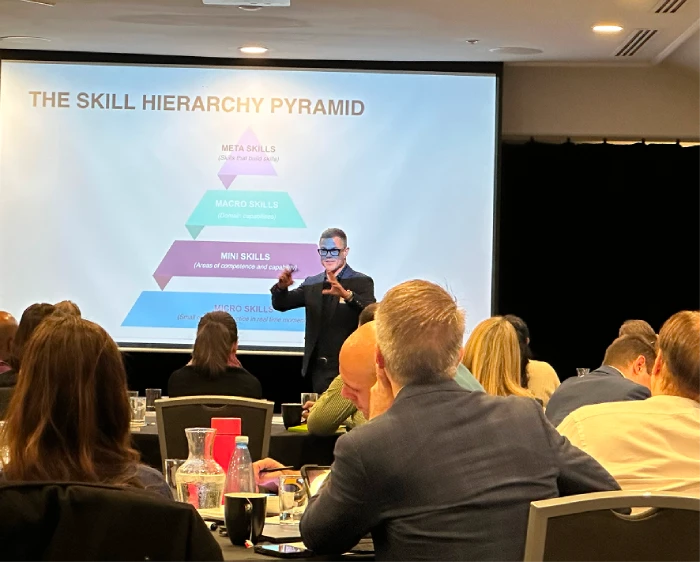
Your strategy says what the organisation must achieve. It does not say what your people must become able to do. We work that out together, resolving strategic intent down through the skill hierarchy until we reach capabilities specific enough to develop and observe
02
Measure where people actually are.
Not a personality profile. Developmental assessment that
shows how your leaders currently reason about the problems their roles demand. This is your
baseline, and it is usually the moment the conversation about your leadership pipeline changes.
03
Build capability in real work conditions.
Leaders build their own development plans using the
four meta-skills, then practise in the work rather than in a room. Their managers are primed and
involved from the start, with something specific to observe.
04
Evidence the change.
Observable behaviour change at the micro skill level, against the baseline you started with. This is what you take back to the executive.
What you get
- Strategic skill maps connecting your strategy to named capabilities
- Assessment data showing where your leaders actually sit, and where the gaps are
- Development plans your people wrote themselves and therefore own
- Managers who know what to look for and how to respond
- Evidence of capability change you can put in front of a CFO
What makes it different
It works at the micro skill level, which is the only level at which practice is possible.
It happens in real work conditions rather than in a room, which is the only place behaviour actually changes.
It involves managers by design, which closes the gap where most programmes leak their results.
And it is measured with instruments built for developmental assessment rather than repurposed personality tools.
WHAT HAPPENED TO RACHEL
She had something to say
She did not leave. She piloted a different approach with a small group of leaders. She focused on specific micro skills. She involved managers. She required practice and tracked it. She measured behaviour change instead of satisfaction.
The results were not perfect. First attempts never are. But they were measurably better. Leaders actually changed. Managers actually coached. Capability actually developed.
And when the next budget meeting came, she had something to say.
“I showed them the data.”
IN THEIR WORDS
From people who ran it
These aren't just career skills. They're a system for developing life skills.
Aaron Zol
Head of Business and Insurance Advice Growth
These aren't just career skills. They're a system for developing life skills.
Aaron Zol
Head of Business and Insurance Advice Growth
WHY ORGANISATIONS DO THIS
Information is not skill.
Only practice builds capability.
Development stops competing with the work.
Every development programme asks for the one thing you do not have. People, away from their jobs, for days at a time. This one does not. People develop through their actual work, in the meetings, decisions and conversations they were already having. A half day workshop becomes months of real practice, because the practice is the work. Nothing gets paused for development. Development happens in the flow of it.
Capability and delivery from the same hours.
Because the skills are mapped to your strategy, developing them is how the strategy gets executed. You are not choosing between building your people and hitting your numbers. The same hours produce both, and culture, capability and capacity move together rather than one at a time.
Your function stops defending its budget.
This is the part people are too polite to say out loud. When you can show what grew, and connect it to what the business achieved, the conversation changes. HR and talent stop being a cost line that survives on goodwill and become the source of an advantage competitors cannot buy. The meeting at the top of this page goes differently.
People get better, not just better at their jobs.
Human beings are built to learn by doing. Most of the way organisations develop people works against that, which is why it feels like an obligation. This returns people to how they naturally learn. The effect does not stay at work. Calmer, more capable, more curious, in every part of their lives. That is not a soft benefit. It is a large part of why it lasts.
THE WAY IN
Start where your budget and your politics allow.
1
Read
Request the book. Subscribe to Leading with Skill. Take the diagnostic.
2
Attend
An executive breakfast. Ninety minutes, twelve people leaders.
3
Try
The wedge: one strategic imperative, one deck, one day, one function.
4
Pilot
One capability, one cohort, one quarter, benchmarked.
5
Build
The Leadership System. Then advisory across the whole chain.
START SMALLER
Not everyone begins with the full system
The Executive Breakfast Series.
Free · Melbourne and Sydney. A small room of HR and talent leaders,
one strong argument, and a conversation with people carrying the same problem you are. I run these on alternating months across both cities. No pitch. You will leave with the four patterns as a diagnostic and a way of thinking about capability that you can use the same week.
Leading with Skill, the newsletter.
One micro skill every fortnight. What it is, the evidence behind it, and how to practise it this week. It is the method working in miniature, which makes it the easiest way to see how I think before you ever talk to me
OTHER WAYS IN
Four more
ONE
Keynote
One room, one argument. For conferences, leadership offsites, and the moments where you need the case made properly to a lot of people at once. Audiences leave with a diagnostic they can apply to their own organisation, not a feeling. Text link: Speaking topics and availability (to the Speaking page; do not duplicate it here).
TWO
Bespoke workshop
One team, one capability. A designed intensive built around the capability your team actually needs. Participants use the four meta-skills to build their own development plans in the room, and leave with artefacts they created rather than materials they were handed. Their managers are primed before it starts.
THREE
Coaching package
One leader, sustained. Developmental assessment to establish where a leader genuinely sits, then structured practice against specific micro skills over months. For executives where the stakes justify precision, and for the people your succession plan is quietly depending on.
FOUR
Retainer
Ongoing advisory. Continuing access across your human capital function. Strategic skill mapping, assessment design, programme architecture, and support for your internal team as they build this capability themselves. For organisations that want to own this rather than keep buying it.
Let’s talk
If any of this is the conversation you are already having internally, the fastest next step is thirty minutes.