
SKILL-BASED LEADERSHIP AND CAPABILITY DEVELOPMENT
Your strategy is the curriculum. Deliver your must-wins and develop your people at the same time.
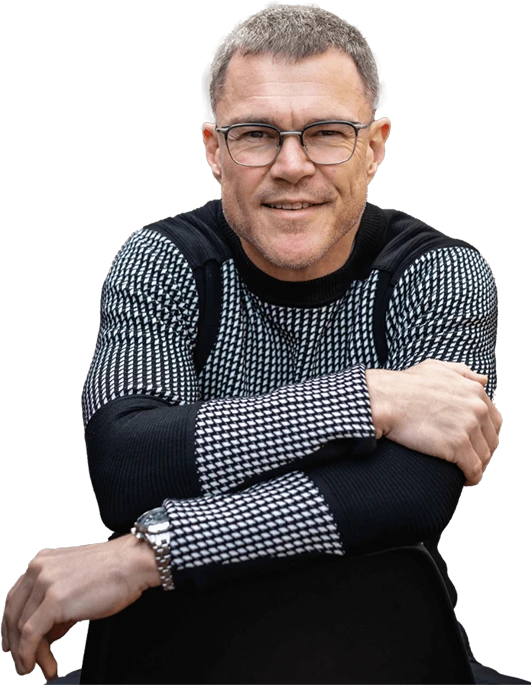
AI is reshaping work faster than any program can follow. The organisations that keep pace won’t have the best content. They’ll have people who learn faster, adapt sooner and make better decisions when it counts.
I design and architect systems where performance and development become the same work. Then I bring them to life, through workshops built around your priorities and keynotes that move a room. Every method is grounded in a century of developmental research and twenty years of practice.
Leadership is not taught in a classroom.
It is built through real world practice.
Your must-wins become the practice.
Your results become the evidence.
Benny Ausmus. Author of Leading with Skill.
Dynamic Skills Digest
Most leadership newsletters tell you what to think.
This one gives you skills you can put into practice – Now No fluff, no pitches. Unsubscribe any time.
Numbers
The State of Leadership Development.
$366B
Spent globally each year on leadership development.
Only 40%
Of leaders say their organisation has high-quality leaders. The steepest decline in a decade.
335
Studies showing leadership development works when it is designed to work. Practice-based methods, spaced sessions, real needs analysis, follow-up. Most programmes ignore all four.
Hope is not a development methodology.
That third number is the important one. This is not an argument that development is hopeless. It is an argument that most of it is badly designed.
THE DISTINCTION
Information is not capability
Knowing about emotional intelligence is not being emotionally intelligent. Understanding feedback is not delivering it under pressure. Learning about strategy is not thinking strategically when the stakes are high. And AI can now hand anyone the knowing in seconds.
Yet most programs still teach people about leadership, then measure whether they remember the frameworks.
No wonder nothing changes.
Capability is made of skills. Break any must win down and you'll find them: Specific, nameable, and small enough to practise in tomorrows meetings.
This is where development becomes possible. Name the skill, practise it inside the work that matters, and measure whether it moved. Your people deliver the priority and grow capability, capacity and adaptability while they do.
Most development is spent. A lump sum on an offsite, gone by the end of the quarter. Development through doing is invested. Every practised skill is a deposit that stays.
Strategy comes to life through Skill
Strategy
says what the organisation must achieve.
Skill
says what its people must become able to do.
Practice
is how they become able to do it.
Measurement
is how everyone knows it happened.
MY LATEST BOOK
Leading With Skill
Make the shift from passive content to active capability.
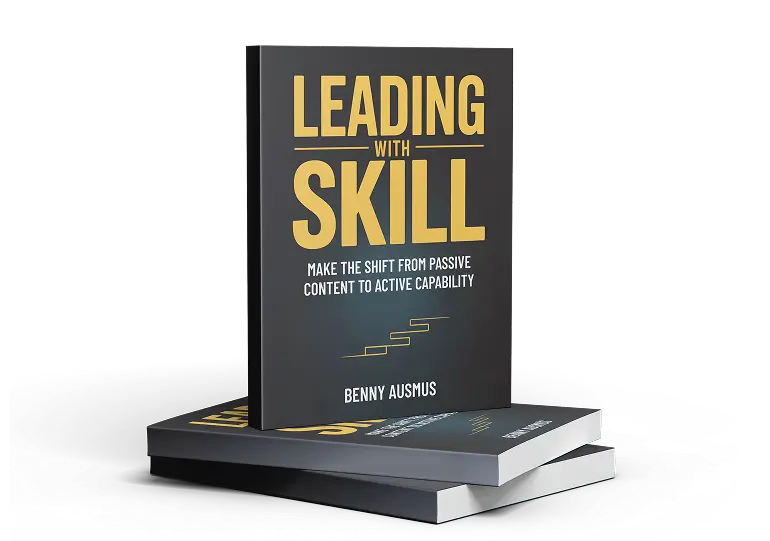
It is not for sale. It is given to people who are working on this problem seriously.
Available for free for a limited time.
Request your copy now.
THE LADDER UNDER EVERYTHING
Most programmes are informative and entertaining at best. We Deliver Results.
Information
Models, frameworks, content. Necessary. Not capability.
WHERE MOST PROGRAMMES STOP
Skill
Specific enough to name, small enough to practise, real enough to measure.
Wisdom
Knowing which skill, when. Grows from the reps.
Results
What the CFO can see.
WHY ORGANISATIONS DO THIS
Development that Compounds Real world performance and Results
Time
A few hours in a room to name the skills. Everything after that runs inside work your people are already doing. A half day becomes months of development, not a day of content.
Money
The skills come from your strategy, so building them is how the strategy gets delivered. The same hours lift capability and move the numbers.
Standing
When you can show what changed, development stops being a cost line. It becomes the reason the strategy landed.
People
People go back to learning the way they learned everything they’re good at: by doing it, with someone watching who can see it. They get more curious, more adaptable, and harder to rattle.
WHY THIS IS DIFFERENT
Four things you wont find anywhere else.
ONE
Validated developmental measurement
I’m a Certified Master Lectical Coach, a PCC, and Certified Professional Lectical Consultant, one of very few in the world. I measure how people actually think, not what they prefer, so growth becomes a number you can trust.
TWO
An architecture that runs all the way down
From the capability your strategy needs, to the skills each person must own, to something small enough to practise in their next conversation. Most models stop several levels above where practice becomes possible.
THREE
A system that produces change on purpose
Prime, Plan, Practice, Progress. It runs inside real work, not in a room, which is why the change survives contact with the job.
FOUR
The same measure at the hiring end
I also run a developmental assessment and recruitment practice. The same unit of measurement runs through both, so the people you hire and the people you grow are measured the same way.
Built around your organisation, designed to adapt, grow and scale with you.
WHERE DOES YOUR FUNCTION SIT?
Five stages.
Most organisations I meet are at two.
The test is simple: what can you honestly say about your development in the budget meeting?
The line between two and three is the moment a skill gets named. Below it, nothing can be practised or measured. Above it, everything can.
Compounding
Managers coach with the method - through the work. Skill is one language and currency.
“We build capability faster than the work changes.”
Evidencing
Baseline, re-measured, behaviour change recorded.
“We can show what changed.”
Practising
Strategy decomposed to micro skills. Managers involved.
“They are practising named skills in real work.”
Informing
Frameworks, offsites, a new model every couple of years.
“They attended.”
Hoping
Feel-good programmes judged on enjoyment.
“They loved it.”
THE SCIENCE BEHIND THE WORK
The measurement is real
Most assessment tells you what someone prefers. Personality profiles, styles, strengths inventories. Useful for a conversation, useless for measuring growth, because preferences don’t develop.
Lectical assessment measures capacity: the structure of how a person thinks. How much complexity they can hold, how they reconcile competing demands, how they reason when the situation is genuinely hard. It’s the life’s work of Dr Theo Dawson, who founded Lectica and built the Lectical Scale on a century of developmental research, from Piaget through Kurt Fischer’s dynamic skill theory.
Because it’s scored against a validated scale, growth becomes a number that means something. Capability shows up in what people do. Capacity shows up here.
That is the difference between believing someone has grown and being able to show it.
One measure across the whole value chain
Role complexity analysis
What does this role actually demand? We measure the level of thinking the work requires before deciding who should do it or how to grow them into it.
Selection
Match people to roles on the capacity the work needs, not on interview polish. Through my assessment and recruitment practice, the same measure that grows people helps you hire them.
Development
Build the skills the role and the strategy demand, then re-measure to show what changed.
Strategy, hiring, development, performance and succession usually speak five different languages. Skill, measured properly, is the one they can share.







IN THEIR WORDS
From the people doing the work.
Any anxiety about 2026/27 KPIs evaporated. At my fingertips I had a map, a sequence, a structure.
Andy Marshall
General Manager
Entireti Alliances
Most leadership programs add value until you walk out the door. This one creates real progression
Jason Capps
General Manager
Practice Development - Fortnum
The leaders of Design & Build have been working with Benny for 2 years and in that time our business has changed greatly, and all for the better
Andrew McGregor
Managing Director - Design & Build Recruitment
Most leadership programs teach you skills. This one teaches you skills to develop skills, a self-improving system
Rhys Heenan
Head of Enterprise Technology
Most leadership programs make you go through a workbook that you put in a drawer. This one gives you real life practice
Jonathan Wykes
Head of Enterprise Innovation
Through working with Benny I have gained clarity and purpose around communication that I was not previously aware of. This has translated into higher levels of conversion in business and more fulfilling relationships with the people around me
Sash Hendrix
CEO - Hendrix & Hart
TWO SITUATIONS
The same method. Two very different problems.
You’re accountable for capability in an organisation
You lead people, talent or a function, and you have must-wins your people aren’t yet able to deliver. A sales number, a delivery problem, a transformation nobody can execute.Development happens, at some cost, and you can’t point to what it changed.I map your strategy to the skills your people need, measure where they are now, build those skills inside the work, and give you evidence an executive will accept.Not ready for a full program? Start with one must-win, your leadership team and one day.
You own the business
Your business can’t outgrow the skill of the people running it, and right now that’s mostly you.Every decision still lands on your desk, and growth means more of your hours, not fewer.I build the leaders and the systems that let the business grow without you in every room.Your team learns to make the calls you’re making now, inside the work they’re already doing.
Nobody ever became great at anything by being lectured at.
We learn the way we always have. By doing the thing badly, in front of someone who can see it, and then doing it again.
Somewhere along the way, work replaced that with content.
Now AI makes content free. What’s scarce is people who learn fast, adapt well and make good calls when it matters. That’s not a personality trait. It’s a skill, and it can be built on purpose.
THE WAY IN
Start where you are
ONE
Read
The Dynamic Skills Digest. Three ideas worth thinking about, three skills to practise before your next big meeting, and the research underneath them. Five minutes to read. Useful by lunchtime.
TWO
Attend
The Executive Breakfast Series, Melbourne and Sydney. A small room of people leaders, powerful ideas and vibrant connection with your peers.
THREE
Get the book
Leading with Skill isn’t sold anywhere. I give it to leaders who are serious about building capability through the work. Tell me a little about what you’re working on, and I’ll post a signed copy to you.
FOUR
Assess
Eight questions, two minutes. Find out which of the five stages your function sits at, and the one move that would shift it.
FIVE
Talk
Bring me your must-win. In thirty minutes we’ll work out which skills it depends on, where your people are now, and whether a workshop, a full program or neither is the right next step. No pitch, just a useful conversation.